
The complete POS guide for barbershops
Taking payment lasts thirty seconds, but it is the last thing the client takes away with them. Worth getting right.
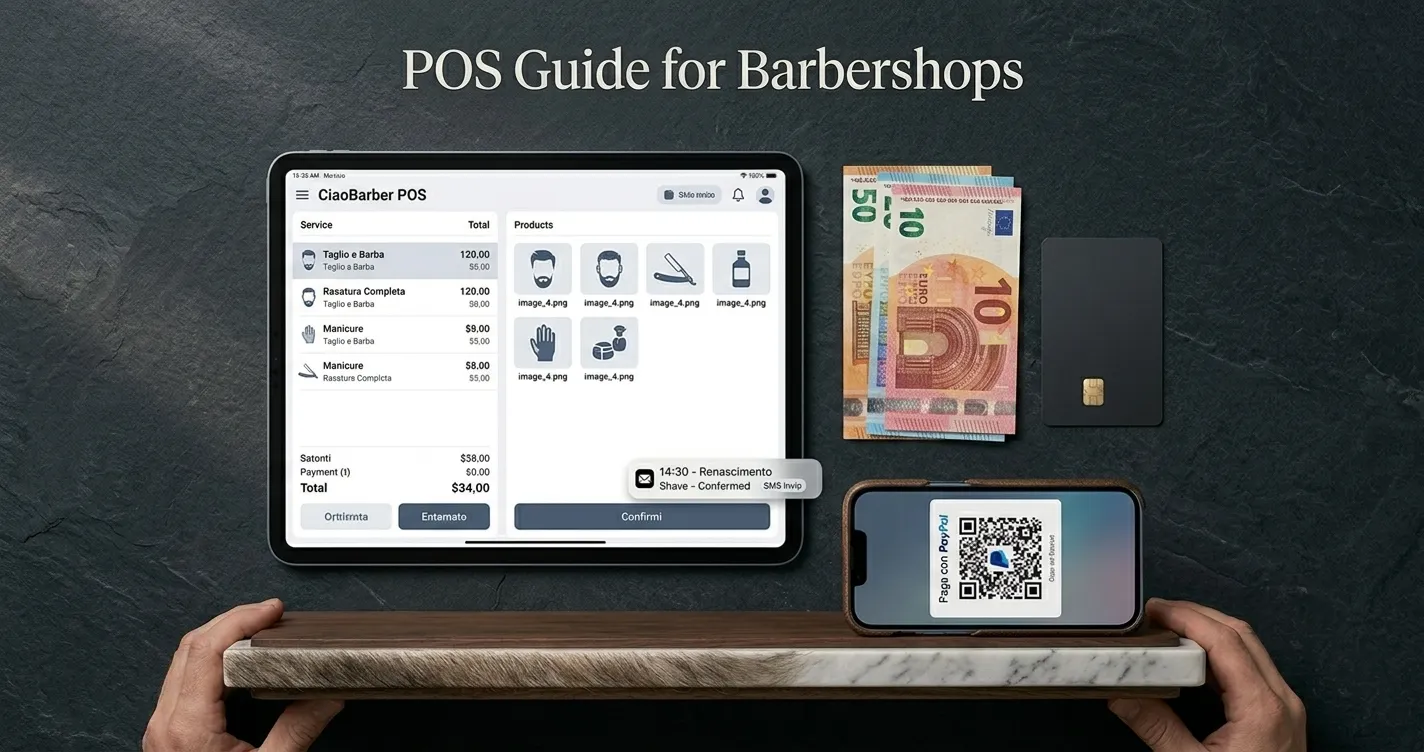
In a barbershop the till is not a separate department. It is the same person who had scissors in their hand ten seconds earlier. Which is why the payment system that works in a shop is not the one with the most features, it is the one that asks for the fewest steps.
What a barbershop till actually has to do
- Close a bill in a few taps, without hunting through a long menu.
- Take cash and card without switching tools halfway.
- Put the service and the product sold on the same receipt.
- Record who took which payment, if there is more than one of you behind the chair.
- Close the day with a total that reconciles without mental arithmetic.
The payment methods, one at a time
Cash has not disappeared from barbershops and will not any time soon, especially on small amounts and with part of the long-standing clientele. Handle it properly, which means starting every day with the same float. That is the only way to tell at closing whether something is missing.
Card is now the default, including the cards living inside phones and watches. The thing to look at here is not the fee on its own but the fee against your average ticket: on a twenty euro cut a flat fee hurts far more than a percentage.
QR payment is the newest addition and it earns its place for two practical reasons. It needs no physical reader, so it still works when the terminal plays up, and it lets somebody with no cash and no patience for a PIN pay from their phone in ten seconds.
Setting up the price list so the till stays fast
Most delays at the till come from a badly built price list. If you have forty entries and use six, every payment turns into a search. Keep the services you genuinely perform every day in front and push the rest to the bottom.
- List the services you performed in the last week and sort them by frequency.
- The top five or six should be one tap away.
- Give every service its real duration, not the optimistic one.
- Keep retail products alongside services, not in a separate list.
- Review prices twice a year rather than once every three.
If there is more than one of you
With two or more barbers the till stops being just a cash drawer and becomes a record. Knowing who performed each service means commission is calculated at month end without argument, and it shows which services pay best for each person. It is also the raw material for any sensible conversation about shifts and hours.
Closing the day
This is the habit that separates knowing how the shop is doing from guessing. Count the cash, compare it against the recorded total and close the day out on the day. Do that for two months straight and you hold something you did not have before: your average take per day of the week, which is where every decision about opening hours starts.
You do not need a complicated system. You need one that does not make you put the closing off until tomorrow.
In short
- Judge a barbershop till on the number of steps, not the number of features.
- Cash, card and QR cover three different clients. Keep all three.
- Check the fee against your own average ticket, not the provider's headline rate.
- A short list of front-and-centre services keeps the till fast.
- Closing the day every evening hands you the numbers you decide on.
Found it useful? Pass it on to another barber.